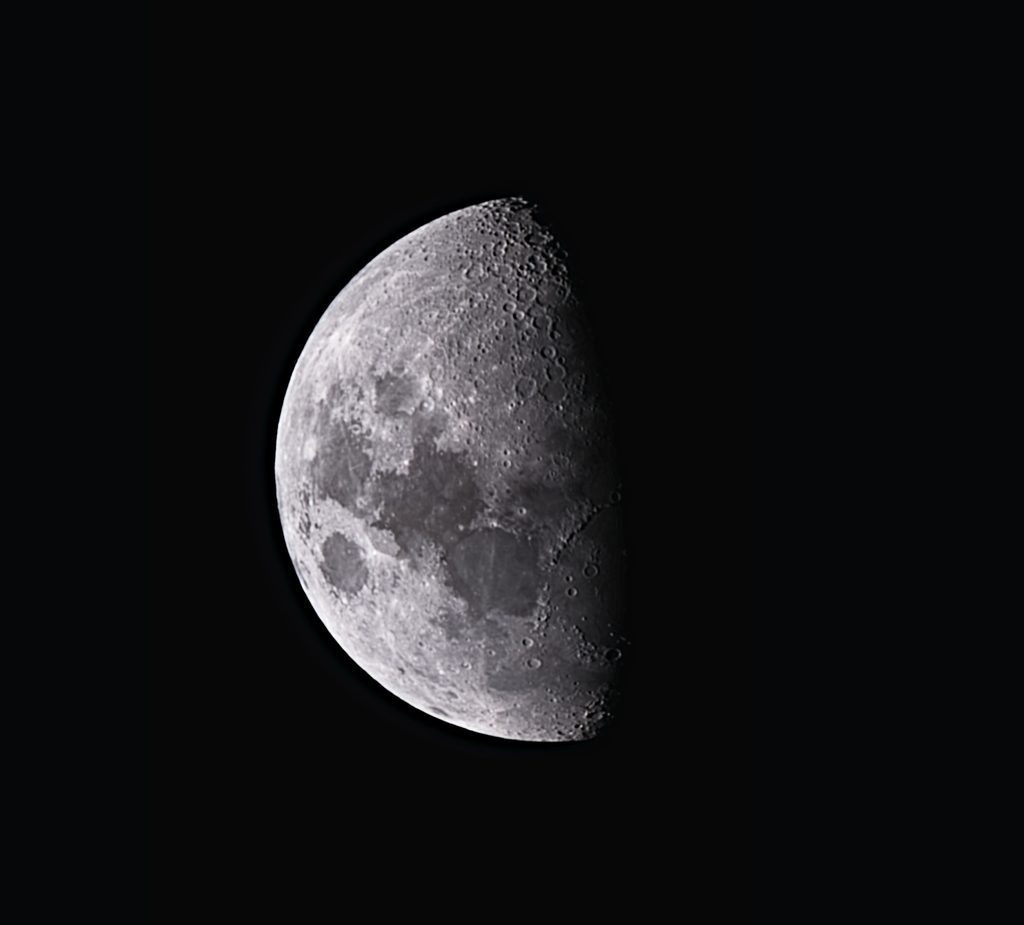
Phases of the Moon

  PHASES OF THE MOON FOR 2026
Times given in UTC (UTC+0)

🌑 New Moon 🌓 First Quarter 🌕 Full Moon 🌗 Last Quarter
Date Time Date Time Date Time Date Time
──────────────── ──────────────── ──────────────── ────────────────
Jan 03 10:04 Jan 10 15:49
Jan 18 19:53 Jan 26 04:48 Feb 01 22:10 Feb 09 12:44
Feb 17 12:02 Feb 24 12:28 Mar 03 11:39 Mar 11 09:39
Mar 19 01:24 Mar 25 19:18 Apr 02 02:13 Apr 10 04:52
Apr 17 11:52 Apr 24 02:32 May 01 17:24 May 09 21:11
May 16 20:02 May 23 11:12 May 31 08:46 Jun 08 10:01
Jun 15 02:55 Jun 21 21:56 Jun 29 23:57 Jul 07 19:30
Jul 14 09:44 Jul 21 11:06 Jul 29 14:36 Aug 06 02:22
Aug 12 17:37 Aug 20 02:47 Aug 28 04:19 Sep 04 07:52
Sep 11 03:28 Sep 18 20:44 Sep 26 16:50 Oct 03 13:26
Oct 10 15:51 Oct 18 16:13 Oct 26 04:12 Nov 01 20:29
Nov 09 07:03 Nov 17 11:49 Nov 24 14:54 Dec 01 06:09
Dec 09 00:53 Dec 17 05:43 Dec 24 01:29 Dec 30 19:00

50 phases total: 🌑 New Moon ×12 🌓 First Quarter ×12 🌕 Full Moon ×13 🌗 Last Quarter ×13

Distance to the Horizon

Have you ever wondered how far can you see to the horizon from an elevated position ? Using simple trigonometry the distance to the horizon along the Earth’s surface can be easily determined. Two cases are considered: (i) light travels in a straight line and (ii) light travels along a curved path as a result of atmospheric refraction. In both cases it will be assumed that the Earth is a sphere resulting in a circular cross section when examining the problem in two dimensions.

Continue reading

Estimating the value of \(\pi\)

\(\pi\) is a mathematical constant defined as the ratio of the circumference of a circle to its diameter. There are many other definitions including the ratio of the area of a circle to the square of its radius. It is a constant that also appears in many formulae used in mathematics, physics and engineering.

\(\pi\) is an irrational number. It cannot be expressed as a ratio of two whole numbers $a/b$. Throughout history ingenious ways have been devised to calculate this constant with increasing accuracy. In this article I’ll describe three methods to determine a decimal representation of \(\pi\) (3.14159…):

  • The Monte Carlo method where we use a statistical approach to estimate the area of a circle
  • The Leibniz formula for \(\pi\) consisting of the evaluation of a simple series
  • Machin’s formula for \(\pi\). A more advanced method using a trigonometric relationship
Continue reading